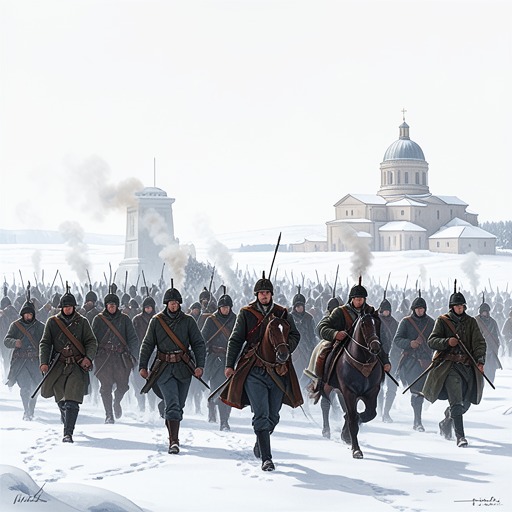
The Battle of Ufa
World War ZThe Battle of Ufa was the first major battle of the Russian offensive during the Zombie War, and its significance lies less in a single tactical triumph than in the doctrine it discredited. The battle showed that conventional urban combat could not reliably defeat the Zombies: artillery, armor, flamethrowers, and massed machine-gun fire produced an inefficient slaughter while faulty weapons and infection multiplied the danger. Ufa became the experience that redirected the Russian Army toward walling cities up during winter rather than repeatedly entering them.
Causes and Military Context
The Russian forces entered the offensive with equipment and methods inherited from an earlier age. The Thirty-second Motor Rifle division, described by its chaplain as a Category D formation, carried PPSH submachine guns and bolt-action Mosin-Nagant rifles, wore the rough wool tunics of its grandfathers, and lacked the newer protective battle dress uniform. Its ammunition was often older than the soldiers themselves, with some cartridges left in exposed crates since before Stalin’s death. A weapon could fail at the instant a Zombie reached a soldier, an event the troops called a “Cugov.”
This material weakness was joined to a doctrine built around overwhelming force rather than economy or precision. Russian units did not employ the compact Raj-Singh squares or the frugal “one shot, one kill” method associated with other armies. Instead, they saturated targets with DShK heavy-machine-gun fire, flamethrowers, and Katyusha rockets, then crushed them beneath the tracks of T-34 tanks. The approach could destroy large numbers of Zombies, but it consumed ammunition, equipment, and lives at a rate the Russian forces could not sustain.
Course of the Battle
Ufa became a prolonged urban assault conducted through rubble and confined spaces. Russian troops advanced after hours of merciless artillery, then fought block by block, house by house, and room by room. Every stage brought the same hazards: too many Zombies, too many misfires, and too many soldiers bitten in the close fighting. The city transformed the ordinary assumptions of urban warfare into a trap, because bombardment did not remove the threat and entering the wreckage placed soldiers within reach of enemies who could not be frightened, negotiated with, or forced to retreat.
The battle also revealed a moral and disciplinary crisis surrounding infection. Russian forces did not possess the L pills used elsewhere to manage infected personnel. The only dependable response was a bullet, yet soldiers could not bring themselves to kill their comrades. The memory of earlier decimations made one soldier’s execution of another intolerable; ordering such an act risked reopening the very mutiny that the decimations had been intended to prevent. Responsibility initially fell to officers and senior sergeants, who had to shoot men they had commanded, lived beside, and sometimes saved or been saved by. The burden damaged leadership at the moment when clear command was most necessary.
Doctrinal Failure and Adaptation
Ufa became the practical proof that the Russian Army could not continue charging into cities. After the first months of offensive operations, the forces began walling urban areas up during winter instead. The change was not presented as elegant reform. It was an admission extracted by casualties, ammunition failures, and the impossibility of maintaining cohesion while asking soldiers to perform intimate executions. The city therefore served as a negative school: its most important lesson was what the army had to stop doing.
That lesson belongs to the wider military transformation of the Zombie War. The failure at Yonkers demonstrated that fear itself could become an ineffective weapon against an enemy biologically incapable of being shocked or awed. Later forces increasingly valued simple, durable, economical systems: the Standard Infantry Rifle was designed for reliability under mud, sand, and saltwater, while Cherry PIE ammunition shattered inside a Zombie’s skull and reduced the need for wasteful burning. The resource-to-kill ratio, developed by General Travis D’Ambrosia, gave this adaptation an explicit strategic principle. Against the Zombies, survival depended on sustainable destruction rather than spectacular firepower.
Historical Significance
The Battle of Ufa stands at the point where battlefield experience became institutional knowledge. Its failure did not merely cost Russian soldiers their lives; it altered the geography and tempo of the offensive by replacing repeated urban penetration with seasonal fortification and containment. The battle’s legacy is thus both operational and ethical. It exposed how obsolete weapons and inherited tactics could magnify a biological catastrophe, while the refusal to make ordinary soldiers kill infected comrades showed that discipline could not erase every moral boundary.
In the larger history of the Zombie War, Ufa contrasts with later systems that emphasized controlled movement, continuous fire, specialized detection, and the efficient allocation of force. The American advance across the continent would eventually use Force Appropriate Response units, halting only the necessary section, platoon, or company when Zombies appeared while the main line continued forward. Ufa belonged to the earlier, costlier phase: a battle in which the army entered the enemy’s chosen terrain, spent lives and ammunition to reclaim rooms one at a time, and emerged with the knowledge that endurance and containment mattered more than the appearance of overwhelming power.